STOCKHOLM’S Hammarby Sjöstad was planned in the early 1990s as Sweden’s showcase for the 2004 Olympic Games.
Although the Games finally went to Athens, the neighbourhood was built anyway and has become one of the most studied examples of sustainable urbanism in the world - not because of any single innovation, but because environmental principles were embedded in every decision, from the first masterplan sketch to the final building on the last plot.
Hammarby occupies former industrial land to the south-east of Stockholm’s centre.
Energy, water and waste flow through an integrated ‘closed-loop system’: biogas from the sewage plant heats homes; waste heat from a data centre feeds the district energy network.
The tram line was running before the first residents arrived - not promised for a future phase or subject to a funding review, but operational on day one.
Buildings vary in architecture and expression, but a design framework - consistently enforced - keeps them coherent without making them uniform. The parks and waterways are structural elements of the layout, not afterthoughts fitted around the blocks.
Edinburgh reads this uncomfortably. Not because the model is unachievable, but because there is a gap between what is actually delivered and what has been aspired to and promised.
It is persistent and rarely acknowledged with any directness.
The recently-approved National Planning Framework (its fourth edition) is ambitious.
It is reflected in the ‘framework’ documentation for the Granton Waterfront, which reads that is super-serious about environmental performance. Similarly, looking at the documents about Winchburgh in West Lothian and Blindwells in East Lothian, both require active travel provision and above-minimum energy standards.
The language is not the problem.
It is what is allowed to be built that will be the final arbiter.
The difference between rhetoric and reality.
Consider the speculative house-building at Western Harbour, before the global ‘financial collapse’ in 2008.
There was a masterplan, a development company was established, the ambitions - mixed uses, high-density urbanism, excellent public realm, sustainable transport - were clearly stated.
But witness today the blocks of flats, many of them discoloured by the salty sea air, along with the cheerless spaces between them, filled to bursting with cars.
Whenever there is a gap between aspiration and delivery, not only is it rarely acknowledged but no-one is ever asked to explain why.
Hammarby worked because Stockholm’s administration stuck firmly to its principles.
The same environmental performance requirements applied in phase 15 were those agreed in phase one.
When developers proposed to reduce insulation standards, the answer was no. The integrated energy, water and waste systems were procured as infrastructure and delivered as a coherent whole, rather than assembled piecemeal from whatever individual developers could be persuaded to contribute.
The result is a neighbourhood using approximately half the energy of a comparable conventional district. It is also, by any measure, a pleasant place to live. Those facts are connected.
Edinburgh has evidence of what this discipline can produce, when applied.
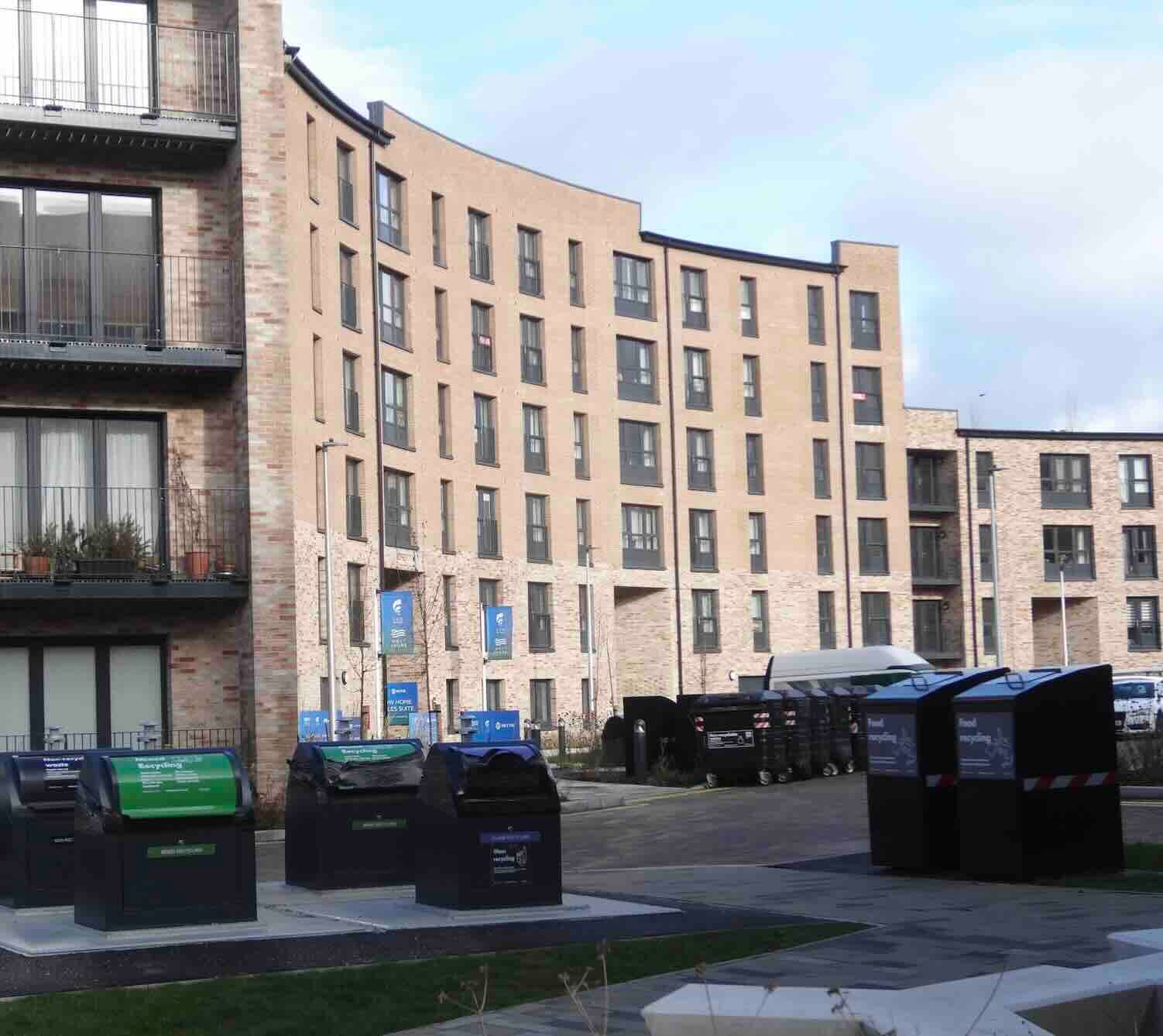
The Edinburgh Home Demonstrator at Granton - delivered by architects, Anderson Bell Christie - is a pilot programme for net-zero (carbon emissions) homes that sets out to prove - on a real site, with real budgets - that high environmental performance and genuine affordability are not in conflict.
If it works, and the early signs are encouraging, it will provide a template that could govern subsequent phases of the Granton regeneration programme. That is exactly the kind of first-phase decision Hammarby’s planners made in the early 1990s: establish the standard, demonstrate it concretely and then hold to it.
The architectural and institutional questions are entangled, especially on those occasions when procurement is driven primarily by cost considerations (not that good design necessarily means more expense).
These last weeks on BuildEdinburgh, the experiences of Regensburg (Germany, here), Lyon (France, here) and Vienna (Austria, here) - when combined with those of Hammarby - have together thrown up several key questions for Edinburgh.
They can be summarised as follows: building around heritage with confidence; extending the city with a governing idea; housing people well as a civic commitment; and embedding sustainability from the start rather than grafting it on later.
They are not separate lessons. They are different angles on the same underlying question: what does a city owe the people who will live in it?
Edinburgh has the talent to answer that question well.
Practices across the city have demonstrated, repeatedly and often on constrained budgets, that architecture here can be contextually serious and genuinely inventive.
James Garry is assistant director of The Cockburn Association
This is an edited version of an article published on the Association’s website, here, for which grateful thanks.
Image details: New housing, Marine Drive, Granton; copyright Mike Wilson


