AT the southern tip of Lyon, in eastern France - where the Rhône and the Saône rivers converge - a peninsula of railway sidings, warehouses and contaminated industrial ground has been transformed into a neighbourhood of 25,000 residents over the past two decades.
The Lyon Confluence project (here) is not primarily a story about what was there before. It is a story about knowing, in advance, what you want a place to become - and having the institutional means to get there.
The Musée des Confluences - by Viennese practice, Coop Himmelblau - makes an architectural statement.
But the project’s real achievement is the coherence of the whole.
The Confluence was designed to become a city quarter - not a collection of individual planning consents that happened to share a postcode.
It achieved this through three things: (1) a co-ordinated masterplan, (2) a public development company - the SPL (Société Publique Locale) - with the authority and long-term mandate to enforce it, and (3) a political will that survived multiple election cycles.
That third element is the hardest to replicate. It is also the most important.
Edinburgh faces versions of this challenge across several sites, simultaneously.
The Granton Waterfront programme - Granton, Newhaven, the northern edge of Leith - is the largest development opportunity the city has faced in generations, with 3,500 homes planned at Granton alone alongside employment uses and a public waterfront on the Firth of Forth.
Shawfair has been under outline permission since 2003 and is only now beginning to feel like a community rather than a construction site.
At Blindwells, in East Lothian, and Winchburgh, in West Lothian, new settlements are taking shape on Edinburgh’s functional edge, housing people who would otherwise have been competing for homes in the city itself.
Growth areas are not peripheral. They are the city in the process of becoming itself - and what they become, Edinburgh will live with for a very long time.
Lyon’s lesson for all of these places is the same: they need a governing idea, held consistently across phases, developers and decades.
Without it, ambition dissolves quietly.
Environmental commitments made at outline stage soften as viability arguments accumulate.
The housing mix promised in the planning statement concentrates into a minimum affordable quota on the least prominent plots. Public realm shrinks. Quality disappears by a thousand small decisions, none of which individually triggers a refusal.
This is not a theoretical risk.
It is what happened at the Western Harbour in Leith.
Here was a site of comparable scale and real opportunity: a former industrial waterfront connected to the historic port, capable of becoming a genuinely mixed urban quarter.
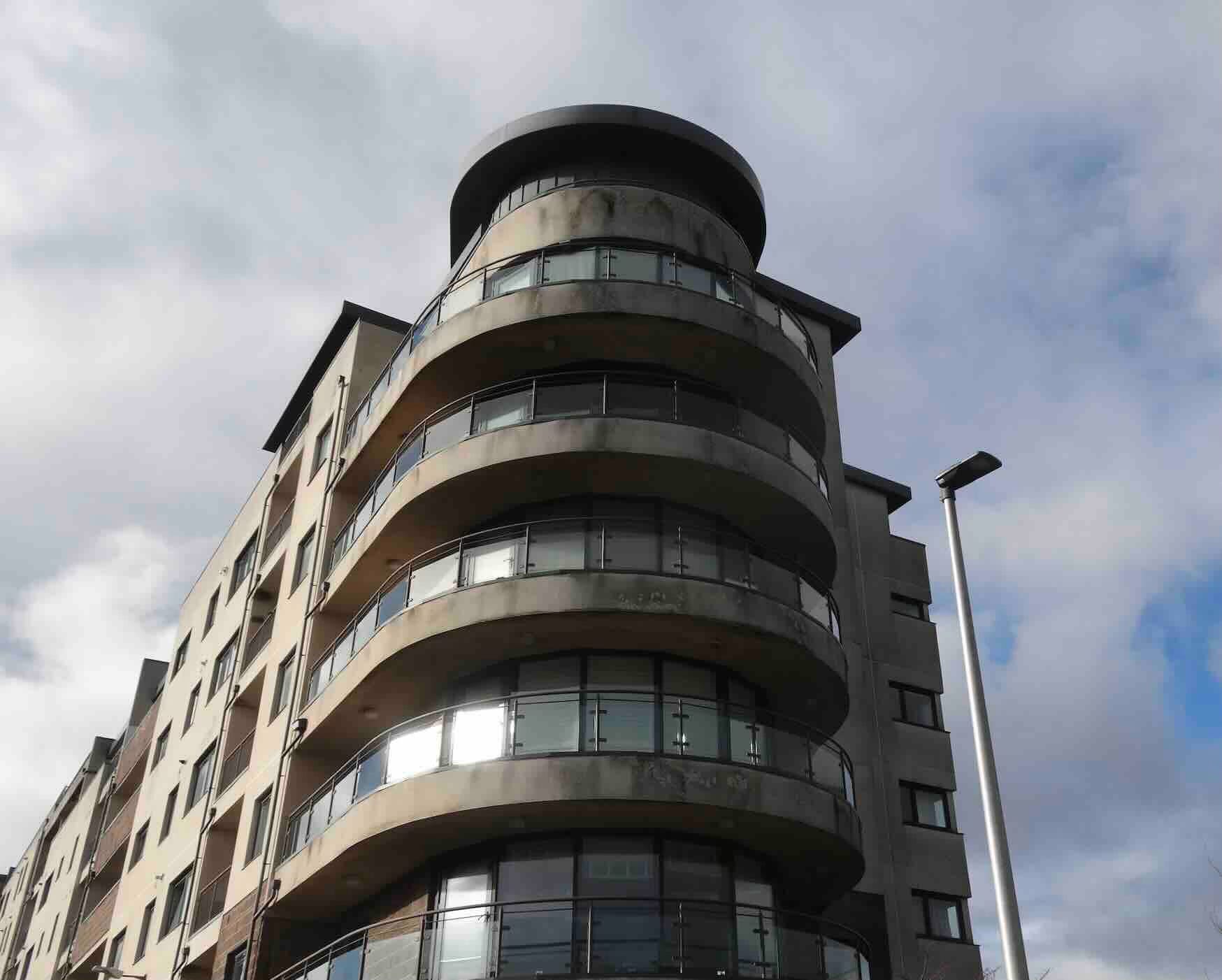
The masterplan existed. The ambitions were stated. But development proceeded piecemeal, driven by speculative developers, in materials - thin render, plastic windows, cheap cladding - that have deteriorated visibly in the coastal climate.
The promised public spaces are inhospitable. The social mix never materialised. A generation of people now lives there and deserve something better.
The contrast with Lyon is institutional before it is architectural.
The SPL could set the terms of development and hold them across 20 years of changing market conditions.
It could select architects through competition rather than simply approving whoever a developer appointed.
It could refuse permission when proposals fell short.
Edinburgh’s planners have some equivalent powers - development frameworks carry real weight when properly enforced - but the willingness to use them has not always matched the stated ambitions.
And the moments when standards erode are usually small enough, individually, to pass without triggering the scrutiny they warrant.
As Professor Miles Glendinning (here) and others have observed (such as here and here), Edinburgh’s planning debates often concentrate on heritage protection - on preventing bad things in sensitive places - rather than on driving quality where heritage constraints are absent.
Growth areas, where the majority of new ‘Edinburghers’ will live, receive a fraction of the attention that a disputed dormer on the Royal Mile can generate.
Lyon also demonstrates something Edinburgh is slow to act on.
The Confluence has not increased pressure on the city’s UNESCO-inscribed historic districts - Vieux-Lyon, the Presqu’île, the Croix-Rousse hillsides.
It has relieved it.
Growth accommodated elsewhere, at genuinely high standards, takes demand off a historic centre that cannot and should not absorb it all.
Investing in quality at Granton is therefore an argument about the World Heritage Site as much as about Granton itself.
A waterfront neighbourhood worth choosing reduces pressure on a centre that is already strained.
At Granton, the council now holds the majority of the developable land - the kind of direct ownership the SPL had.
The Development Framework was adopted in 2021.
First-phase housing is under construction, with architects, Anderson Bell Christie, delivering the Edinburgh Home Demonstrator: a pilot programme for net-zero carbon emissions homes that, if it works, will set a template for the phases that follow.
But the Western Harbour also had a masterplan, a development company and political support.
What it did not have was the sustained institutional discipline to hold to those ambitions, as development dragged across 15 years and two financial cycles.
Granton will take similar time.
The question is simply whether Edinburgh will hold the line for that long. Lyon, over 20 years, did.
James Garry is assistant director of The Cockburn Association
This article is a tweaked version of a column on the Association website, here, for which grateful thanks.
Further reading: on BuildEdinburgh: Another Take on Granton, here.
Image details: Granton; copyright Mike Wilson


