

IF it has been ever thus that Scotland’s colleges take today’s young people and teach them to become tomorrow’s joiners, electricians and plumbers, it has also been ever thus that they require to keep abreast of changing technologies.
One such educational institution that can reasonably lay claim to being among the more far-sighted is West Lothian College, in Livingston.
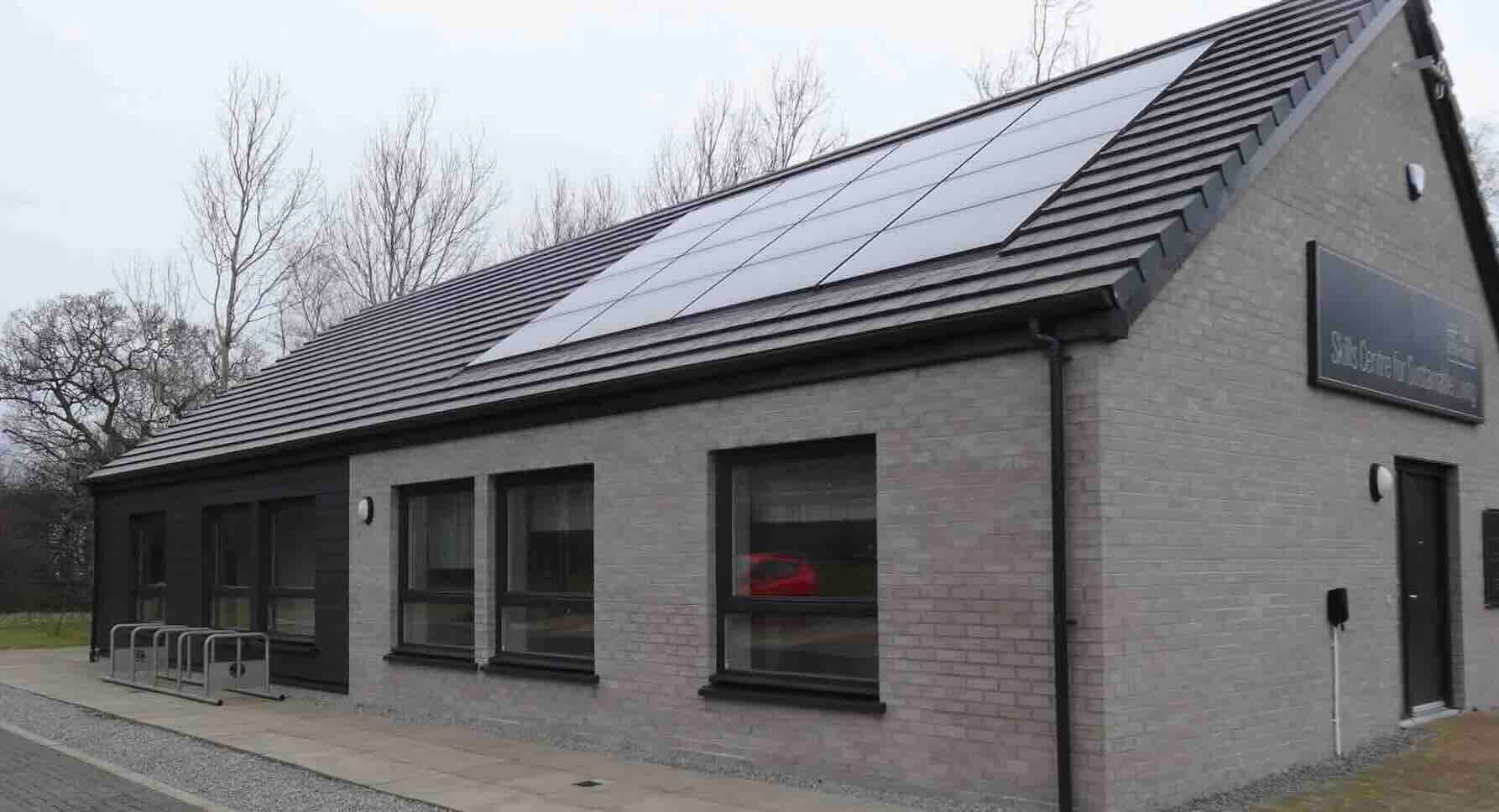
Its standalone ‘ECOHOUSE skills centre for sustainable living’ (here) is a clever response to the list of growing demands that we, as a country, are beginning to make of our new housing.
You find ECOHOUSE at the very entrance to the college, one part externally finished in brick, the other in fibre cement.
The split is more than purely aesthetic. They speak of a before-and-after division, one half of the building showcasing what can be achieved, the other half all about how to physically deliver it.
Officially opened 18 months ago, ECOHOUSE has always been a teaching resource, aimed at students pursuing the college’s many built environment courses (here).
But, given that it’s all about the latest in carbon and resource-efficient technologies, it helps to keep fully abreast of the latest innovations.
On entering the ‘fully finished’ half of the building, two doors immediately to the right lead to ‘plant room’ cupboards. One of them is taken up by a large hot water cylinder which is part of an air-source heat pump system, and which serves room-by-room underfloor heating and the water for the house.
The other room looks like a 3D relief map of all that’s possible in the modern-day home, including solar panel controls, mechanical ventilation heat recovery and internet-enabled access and lighting. Waiting to be installed is an energy storage battery and accompanying ‘inverter’, to store surplus solar energy in an useable form for the house.
In the kitchen area, the plan is for it to become fully wheelchair-accessible, to enhance the learning experience of the college’s health and social care students.
The second half of the building is like a real-world construction site, with insulation boards waiting to be fitted, a heat pump to be installed, underfloor heating pipes at the ready, window and door voids to be filled and joins to be taped to help ensure air-tightness.
Begins Steven Morrison, director of Computing, Engineering and the Built Environment at the college: “The whole house sits within a thermal envelope - there is insulation in its foundations and both internal and external wall insulation, plus in the ceiling and roof space.
“It has been built to Passivhaus standards.
“Air tightness is crucial; the slightest hole can have a huge impact on your energy efficiency.
“There is no gas coming into the house, a lot of the energy required is self-generated, and we hit platinum or gold level on all the building standard section headings such as emissions and water use.”
Some of the kit has been provided by locally-based operators, such as the air-source heat pump by Mitsubishi and a real-time data analysis panel provided by J-TEQ EMS Solutions.
But for all that the building footprint is well over 100 sqm, at a build cost of almost £500,000 (back in 2023), the question remains: might Morrison’s students be graduating with skills that no-one can afford to employ?
Morrison is emphatic: “One hundred per cent no. These skills are vital as we continue to raise standards and make homes more sustainable to achieve the country’s net [carbon emissions]-zero targets.
“While not every new house in the future will be built exactly to the high standards of ECOHOUSE, we want to inspire our students to keep raising the bar.”
Partners in the project included Glasgow-based architects, MAST, and Ayrshire-based building firm, McTaggart Group.
Says Morgan Stephen Milne, associate and project architect at MAST: “In the coming years, we will likely see significant changes in building regulations aimed at improving energy efficiency and reducing carbon emissions.
“Achieving these new targets will require considerable upskilling across all levels of the workforce. The ECOHOUSE is equipping students with the skills, knowledge and hands-on experience essential for the success of sustainable construction and technology.
“By preparing the next generation of professionals, they are ensuring we have the expertise needed to meet future regulations and enhance the energy efficiency of our buildings.”
Adds Ross Hammell, manager, corporate social responsibility, at McTaggarts: “The ECOHOUSE project isn’t just a dwelling; it’s a blueprint for a sustainable future.
“Not only does it demonstrate what’s achievable in building a net-zero carbon economy, it’s actively cultivating high-value green jobs, upskilling our workforce, and placing West Lothian at the heart of sustainable development.
“Moreover, it is pioneering smart technologies for independent living, ensuring a legacy of innovation and skilled workers for the housing sector.”
Continues Morrison: “So far, it is only our construction skills students that are being taught in the ECOHOUSE - albeit, we have hosted several Open Days over these last 18 or so months and have frequently welcomed visits from ‘the industry’. But soon enough, we expect them to be joined by our health and social care students.
“We increasingly require to recognise that housing needs to work for us at all stages of our life.
“We are so fortunate to have this great facility at the college to support our students develop the necessary and vital skills for what is an ever-changing construction industry and help achieve our net-zero targets.”
Mike Wilson is editor of BuildEdinburgh.com
Image details: copyright Mike Wilson