

TURNING off the busy West Granton Road, Madelvic House stands out from the crowd. On a sunny evening, its Victorian red bricks glow warmly. Living close to it is vital to my wellbeing and representative of Granton’s fascinating heritage.
Modern blocks of flats stand on one side of this treasure of a building; on another are cottages dating from the 1930s.
Opposite is a beautiful sycamore tree and the brick and metal casing of United Wire, who have been in business for over 200 years.
Adjacent are the remains of what is believed to be the UK’s first electric car factory, where prototypes were driven on a roof track for testing - around 1900.
Madelvic House is in the midst of this eclectic environment. It celebrates the good company it is in and holds the history of the community it belongs to.
Once at the forefront of the innovation and wealth-building that made Granton so important, Madelvic House is currently in the heart of acres of hasty new housebuilding and a place to which I regularly return.
On Mondays, I stretch, twist and do my ‘downward dogs’ in the Sphinx Room yoga class.
Early on Fridays, I go to sit in meditation there and then share a convivial breakfast.
At weekends, I am inspired by visiting art exhibitions. I love that classes and workshops, meeting rooms, studios and space to show artwork are available to us all so near to home.
In 2023/24, I was the development worker at the Granton Archive Project that occupies the William Peck Room.
More and more people are coming to live close by, or to visit the commercial outfits springing up; The Pitt street food, community hub and venue is just a 15-minute walk away.
Meanwhile, community arts group, Granton:hub, and Forth Children’s Theatre are both tenants of Madelvic House.
I run walking trips around Granton and find myself constantly singing the praises of Madelvic House, for two very simple reasons: its sense of history and the friendliness and enthusiasm of the people who work and volunteer there.
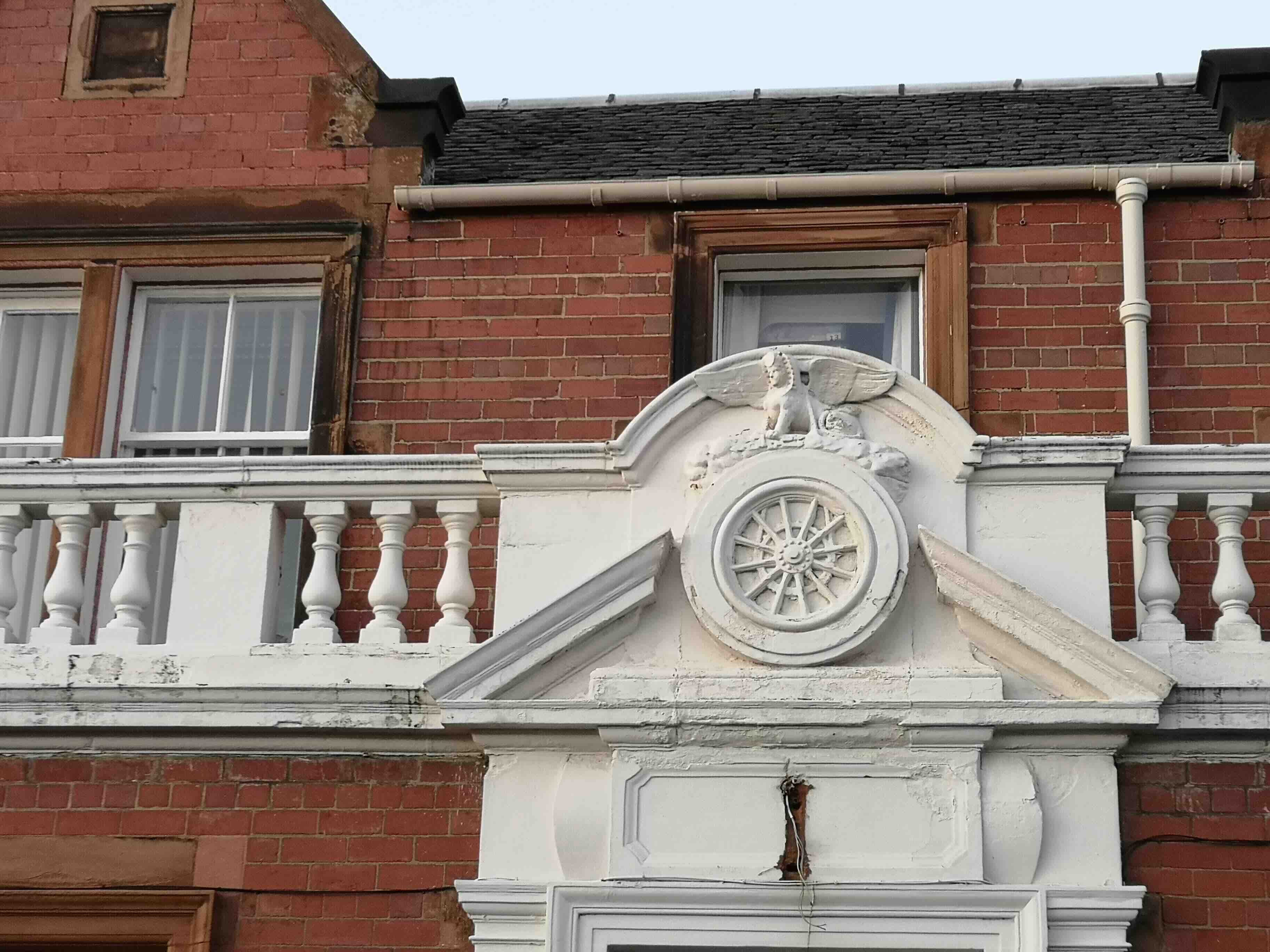
There is pride too: Madelvic House has been awarded ‘red wheel’ status (here) by the charity, the National Transport Trust, and of course there is the elegance and poise of the building’s architecture: the classical, white balustraded parapet, the broken pediment and pilastered front entrance.
What excites me the most is the façade’s decoration, built by William Peck in 1898.
Above the door is a wheel, the ‘fifth wheel’, which was a part of the electric car manufactured by the Madelvic Motor Carriage Co.
Perched on top of that is a sphinx (a goddess-lion-eagle hybrid) but the reason it is there is a riddle which, for long enough, I was not able to solve. Until now.
Peck - who held the office of city astronomer - was an Egyptophile. He was a member of the Hermetic Order of the Golden Dawn and attended the Amen-Ra temple in Edinburgh, named after the temple of the same name in Luxor in southern Egypt, famous for its Avenue of Sphinxes.
It is likely that he chose a sphinx for Madelvic House as a reference to this, to guard the mysteries inside and act as a warning to those who entered that they should conceal all knowledge learned within.
It makes sense that an innovative business might choose such a symbol, and it brings the whole story alive.
There is so much more to the architectural gem that is Madelvic House. The sadness is that it is mostly overlooked, perhaps because Edinburgh is so rich in beautiful buildings.
BuildEdinburgh readers have the chance to enjoy the building, as I do, by signing up to visit it for ‘Doors Open Day’, on the 26th of next month, here.
Tamsin Grainger has been a Zen Shiatsu practitioner since 1991, and, more recently, a practising artist whose visual, written and textile-based work arises directly from her walking practice. Her next exhibition will be at Madelvic House, on October 23-25.
Also on September 26, Tamsin is leading ‘Knots’, a community walk down to Granton harbour and back, to celebrate the wire mesh and fishing industries. Details here.
Image details: copyright Tamsin Grainger