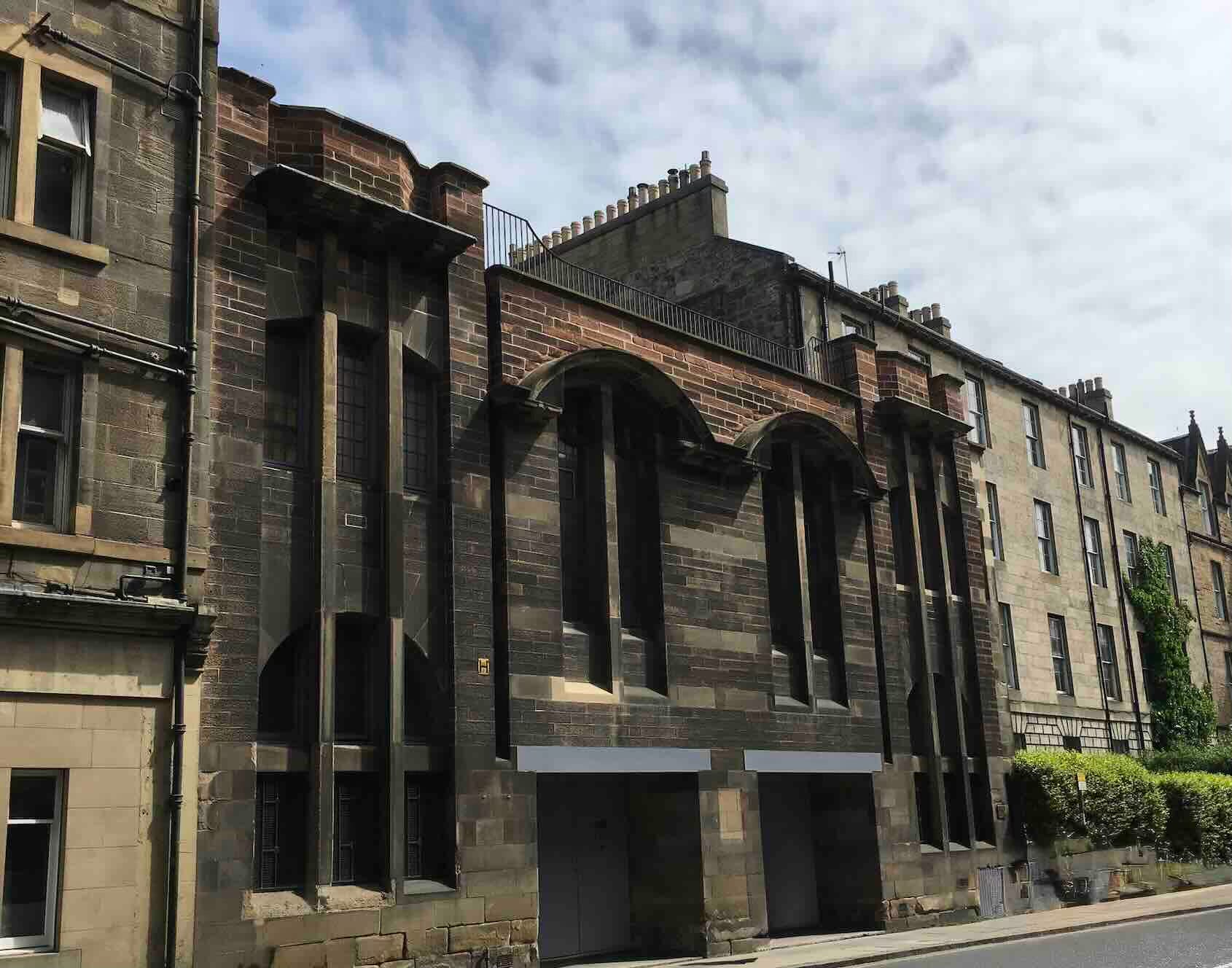
AN unconsidered trifle - such as Joseph Marr Johnston’s Duke Street Church Halls, in Leith - always catches my attention; its modest appeal often masking a larger truth.
Leith expanded from a population of 10,000 in 1800 to 70,000 by 1930 although growth slowed after the port’s unpopular amalgamation with Edinburgh in 1920.
Imports of tea, grain and timber, exports of whisky - no port exported more whisky than Leith - and shipbuilding created this growth and the career of local architect, Johnston.
He had a sound training with ‘Scotland’s premier architect’, Robert Rowand Anderson, among others, working on the McEwan Hall and the National Portrait Gallery, sufficient to set up in independent practice in Leith in 1900.
In 1904, he won the architectural competition for the Seafield Poorhouse in a Scottish Art Nouveau or ‘Glasgow School’ idiom of white render, red sandstone dressings, prominent oversailing eaves and distinctive ventilator housings - not dissimilar to Tynecastle School of 1911 - worth £11.5m today. It was converted to the Eastern General Hospital in 1931 and demolished in 2008.
The Duke Street Church Halls followed in 1907, with Johnston further developing his ‘Glasgow School’ aesthetic.
This knowledgeable, clever and expressive red sandstone elevation merits close study.
It consists of two central bays flanked by pavilions. In the pavilions, the mullions of the recessed Diocletian windows on ground and first floors - the upper with a flatter arch - are projected into continuous pilasters providing support for the deeply-projected canopies and canted parapets, linked by simple ironwork, above.
Just below the canopies are chequerboard panels of variegated coloured sandstone.
The central bays are differentiated from the pavilions by deep grooves rising from the ends of the steel lintels over the entrance doors and which in turn align with the transoms in the adjacent windows.
The arched windows beneath the deeply-projected flat-arched hood lintel have the inverted gothic tracery favoured by Johnston’s Glasgow contemporaries and also found at St John’s Portobello, 1903.
Although obscured by 120 years of soot, there is evidence of further multi-coloured ashlar masonry banding linking the sills and lintels in the pavilions across the central bays.
So what’s the larger truth I started with?
Johnston himself had some inkling of it.
Like many a locally-based architect, immersion in that work separated him from his peers and from wider recognition.
He observed, in 1911, that “during the last ten years or so I have been so much tied up in this town [Leith] as to have got out of touch with the members of the Institute with whom I am acquainted and have some reluctance in asking them to vouch for me now as I have no reason to believe they are acquainted with work I have done.”
Little known then, almost unknown today, Johnston has suffered from the narrow interpretation of Scottish Art Nouveau as being the sole property of Charles Rennie Mackintosh.
Mackintosh’s sun shines so bright it has left most of his contemporaries in crepuscular shade. He’s the default subject for the lazy writer with an eye to easy sales, who has nothing new to say, reliant on third-hand sources for decades.
I love Johnston’s Duke Street Church Halls for its being a little gem of ‘Glasgow School’ in Edinburgh, for its survival and for its signifying of a richer history of Scottish architecture between 1895 and 1915 yet to be written.
I passed this building every school day for 13 years, attended Cub Scout meetings there and, in my schoolboy ignorance, gave it no mind.
Roger Emmerson is the author of three architecture books: Matt Steele, Architect: a biography; Land of Stone: a journey through modern architecture in Scotland; and Scotland in 100 Buildings.
Image details: copyright Roger Emmerson; text copyright Roger Emmerson


