

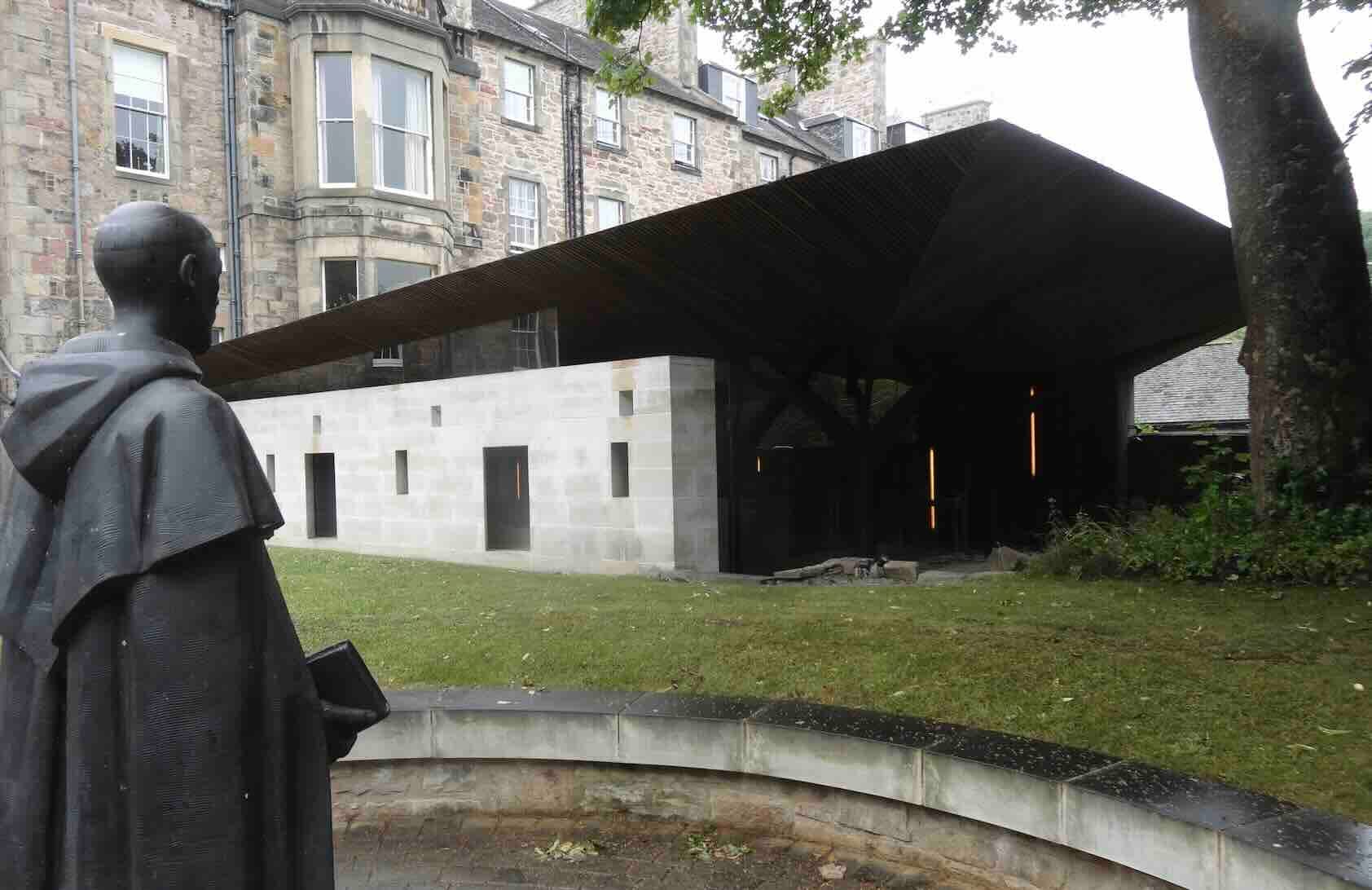
MY favourite building in Edinburgh is one many people pass without quite seeing: the Chapel of St Albert the Great, tucked quietly behind the Georgian terraces of George Square, beside Middle Meadow Walk.
There are grander buildings in the city, older buildings, more elaborate buildings and buildings that command the skyline. But this modest chapel is the one that stays with me.
Part of that affection is deeply personal. Part of it is architectural. Together, they make this one of the city’s most remarkable modern buildings.
When I first arrived at the University of Edinburgh in the late 1980s to study for my MSc, the chapel that exists today had not yet been built. The Catholic Chaplaincy occupied rooms within the Georgian houses on George Square. It was a much humbler setting, but one that became an important part of my university life.
Like many students arriving in Edinburgh from elsewhere in Scotland, university could sometimes feel anonymous. Lectures, libraries and laboratories filled the days, but St Albert’s offered something different: a place where people knew your name, friendships formed easily, and conversations ranged far beyond academic life.
Those memories remain among the happiest of my time as a student.
Returning years later to discover the new chapel was therefore a moment of genuine delight.
Rather than reproducing a traditional church, the architects created something unmistakably contemporary while remaining profoundly respectful of the building’s purpose.
Completed in 2012 and designed by architects, Simpson & Brown, the chapel has deservedly received wide architectural recognition. It demonstrates that modern ecclesiastical architecture can be both innovative and deeply rooted in tradition.
What impresses me most is not simply the quality of the architecture, but the way it creates atmosphere.
From Middle Meadow Walk, the chapel reveals itself only gradually.
It sits quietly within its garden, neither competing with the 18th-century townhouses nor attempting to imitate them. Instead, it finds its own language through restrained materials, careful proportions and thoughtful detailing.
The sandstone walls anchor the building firmly to Edinburgh’s architectural tradition, while the great curved roof introduces warmth and movement.
Four weathered Corten steel columns rise like the trunks of trees, supporting an oak-lined ceiling that appears almost to float overhead. The effect is surprisingly organic, as though the chapel has grown naturally from the garden rather than simply been placed within it.
Inside, the experience becomes even more compelling.
Architecture often succeeds not because of what it contains, but because of what it allows us to feel.
The interior of St Albert’s is calm without being austere. Light enters indirectly, filtered through carefully positioned glazing and reflected across the oak ceiling before gently illuminating the worship space. There is very little distraction. Instead, attention is drawn naturally towards the sanctuary.
It is an object lesson in how daylight can become a building material in its own right.
Perhaps the most beautiful feature is the great glazed wall behind the altar. Rather than presenting stained glass or elaborate decoration, it opens directly onto the garden beyond.
Throughout the year, the changing seasons become part of the chapel’s interior life.
Spring blossom, summer greenery, autumn colour and winter light each find their way into worship. Nature becomes part of the liturgy without a single spoken word.
For someone interested in architecture and landscape, this dialogue between inside and outside feels entirely appropriate.
Edinburgh’s best buildings have always understood their setting. This chapel continues that tradition in a thoroughly modern way.
Yet it is more than simply well-sited. Through its generous glazing and its relationship with the surrounding gardens and pathways, it remains anchored in the everyday life of the university.
Students crossing Middle Meadow Walk, changing seasons, birdsong and weather all become part of the experience of the building.
Rather than turning away from the world, the chapel gently embraces it, reminding us that faith is lived not apart from daily life but within it.
There is another reason why I value the building.
University chaplaincies occupy an unusual place within the life of a city. They are neither wholly academic nor wholly ecclesiastical. They provide spaces where students from many backgrounds encounter questions of purpose, ethics, friendship and belonging alongside their formal studies.
That was certainly my experience. Looking back nearly 40 years, I remember not only the liturgies but the people: fellow students, chaplains and volunteers whose kindness created a genuine sense of belonging.
The chaplaincy was woven naturally into the rhythm of university life. One could drop in after lectures, meet friends over coffee, attend Mass, or simply find a quiet place to gather one’s thoughts before returning to the demands of study.
The new chapel reflects that same openness. It is unmistakably Catholic in its liturgical purpose, yet its architecture feels generous rather than exclusive.
It invites stillness without isolation. Even when empty, it possesses a quiet hospitality that welcomes visitors to pause for a few moments before returning to the movement and activity of George Square beyond its walls.
As someone who now spends much of his professional life thinking about Edinburgh’s built and natural environment, I often argue that successful buildings and their surroundings contribute something beyond their immediate function. They enrich the public realm. They make places memorable. They help shape how people experience a city.
The Chapel of St Albert the Great does all three.
It also reminds me that architecture is ultimately about people. Buildings become meaningful because they gather memories as well as occupants.
Every visit reconnects me with friendships formed nearly 40 years ago, with the excitement of arriving in Edinburgh as a young post-graduate student, and with the sense that the city was opening itself, one discovery at a time.
The old chaplaincy gave me many of those memories. The new chapel gives them a beautiful architectural home.
In a city celebrated for castles, monuments and Georgian crescents, my favourite building is a modest chapel hidden in a garden: quiet, generous and easily missed.
Perhaps that is exactly as it should be.
James Garry is assistant director of The Cockburn Association
Image details: copyright Mike Wilson