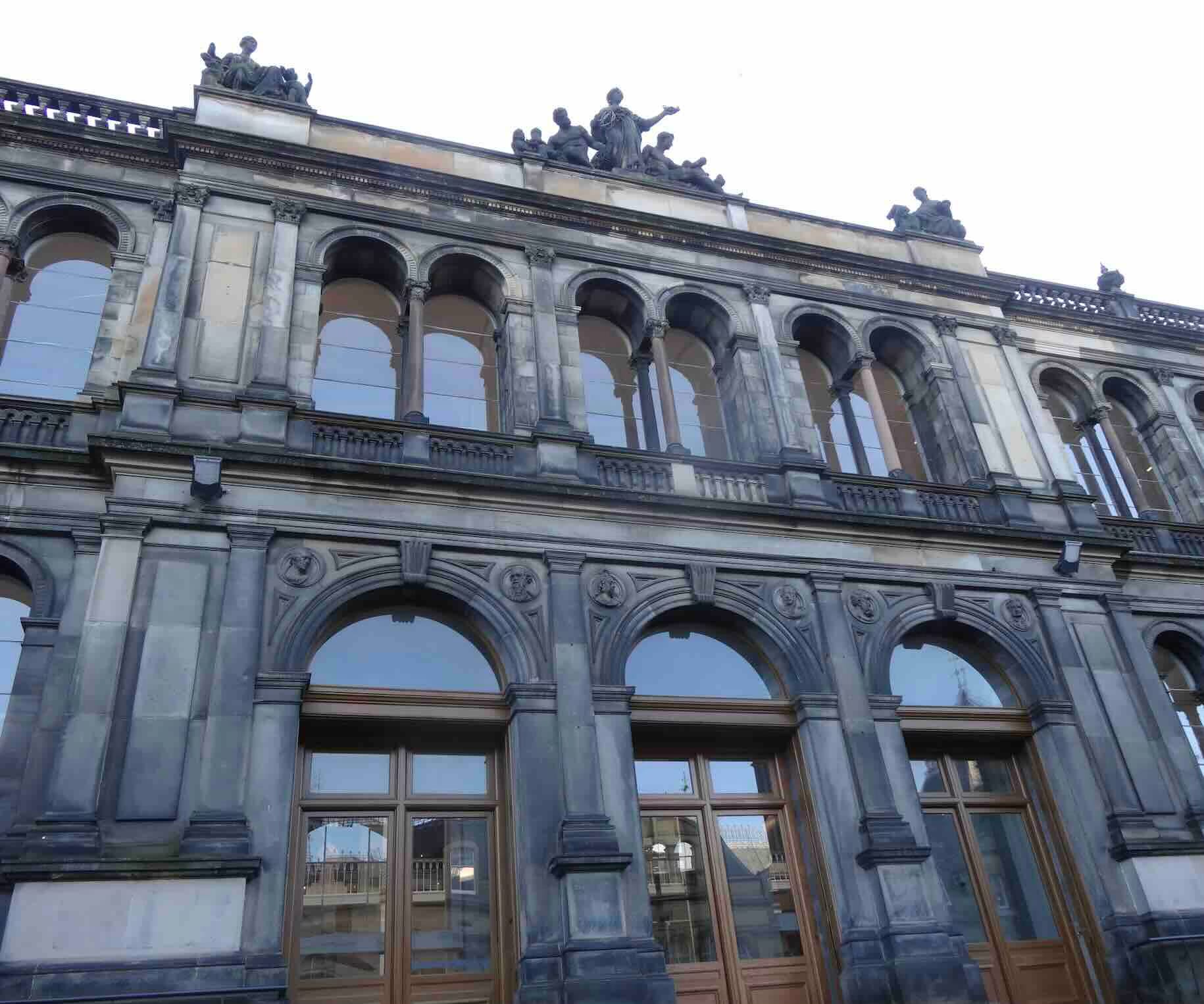
I GREW up in Edinburgh and would often travel by bus to The Royal Scottish Museum in Chambers Street where I would spend the afternoon wandering about looking at the displays that encompassed science and technology, natural history, and world cultures.
There were stuffed animals from all over the world, scientific equipment, steam locomotives, engines (some neatly cut in half to show how they worked), and human-made objects and artefacts of all kinds.
It was quite simply the most exciting place I had ever seen.
By the end of primary school, I had decided that the natural sciences were what I found most interesting and here was an extraordinary treasure house, right on my doorstep.
I was sure that this was somewhere I could learn everything that was worth knowing about.
In modern vernacular, I had found my happy place.
I often entertained the idea that, one day, I might hide somewhere when the closing bell was rung in order to get myself locked in for the night.
I would be prepared with sufficient food and a torch and didn’t even consider what would actually happen if I ever made my daydream a reality.
The inevitable search party, police involvement not to mention anxious, then increasingly irate, parents.
Fantasies of what might happen in museums after dark have since been the subject of very successful books and films, and organised sleepovers are de rigueur. I really missed out.
The building was designed by Francis Fowke, the Irish engineer and architect.
It started life in 1861 and was partially opened in 1866.
It has a Renaissance-style façade with a glazed roof supported by cast iron pillars and arches that rise the full height of the building.
Before the building underwent a major refurbishment, reopening in 2011, you would ascend the wide steps from Chambers Street to the massive double doors and into the light-filled space of the grand central hall, as if climbing to receive wisdom from the high altar of learning.
Nowadays, street level access takes you through what were once storage cellars - a little less grand.
At the western end of the building was a huge Canadian red cedar totem pole, its painted animals staring out over the great glass-covered hall where there were two large shallow tiled fish ponds into which visitors would toss coins for good luck.
The ponds have gone and the totem pole, which had been carved in 1885, was rightly returned to the Nisga’a people of British Columbia, three years ago, having been taken from them around 1930.
Another of the displays I remember from my childhood visits to the Royal Scottish Museum was the mesmerising Foucault Pendulum suspended from a very long wire fixed to the roof.
The pendulum was invented in 1851 by French physicist, Léon Foucault, to demonstrate the rotation of the Earth and, although Edinburgh has lost this little bit of scientific wonder, Foucault pendulums are still swinging elsewhere in the UK.
Francis Fowke, who was also involved in the design of the Royal Albert Hall, died suddenly of an aneurysm at the age of 42, not long after the Chambers Street museum was fully opened.
Before he died, he had won a competition for the design of the Natural History Museum in London, which was later remodelled and completed by Alfred Waterhouse and it was here that I studied for my Doctorate.
Later, I was employed in the Entomological Collections of the Oxford University Museum of Natural History where, as an academic, I worked for a quarter of a century before leaving to go into broadcasting.
This handsome Neo-Gothic building was designed by another Irish engineer and architect, Benjamin Woodward, who like Fowke, died at the height of his career.
Tuberculosis took him at the age of 45, only one year after the museum opened in 1860.
I consider myself very fortunate indeed to have had two dream jobs in my life and my early visits to Chambers Street Museum were the initial inspiration for the development of both.
George McGavin is an entomologist, author, academic, television presenter and explorer. His TV programmes include Oak Tree: Nature's Greatest Survivor, After Life: The Strange Science of Decay and The Lost Land of The Volcano.
Image details: copyright Mike Wilson; text copyright: George McGavin


