

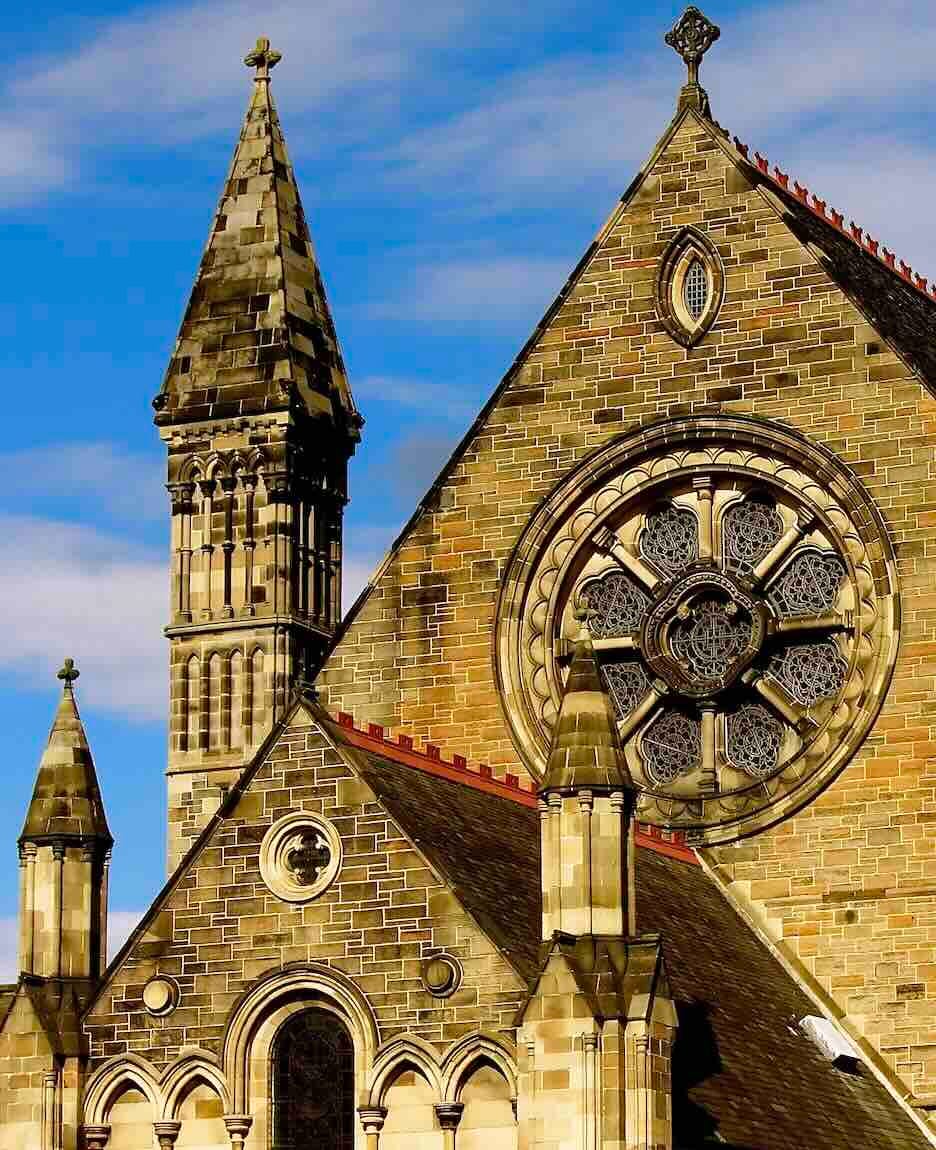
IT must be Norman. This was the main design stipulation of the 1872 competition for a new church on sloping ground in Low Broughton.
The Catholic Apostolic Church already had a modest presence on Broughton Street, but its leaders wanted something larger and more impressive. They sought a home which would let the congregation grow and give full expression to the elaborate rituals of their worship.
Its spaces should evoke piety and grandeur, awe and exultation but in an architectural style free of perceived ‘papish’ excess.
Robert Rowand Anderson’s winning response was an exercise in massive restraint, which still cheers and solemnises at the corner of East London Street and Mansfield Place.
Measuring 200 ft x 45 ft, its roof summiting at 77 ft, the walls 4 ft 6 in thick, this was an imposing statement of faith at the New Town’s edge. It could accommodate 700, although it’s doubtful whether regular attendance exceeded 150.
The Church was in part a charismatic response to certainties overturned by the French Revolution.
It was formally constituted in London in 1835 by founders who foresaw an imminent Apocalypse and Second Coming.
Their buildings and liturgy were designed to honour the mysterious but real presence of Christ during Eucharists, and to welcome His arrival when the Millennium dawned.
By tithes and donations, affluent worshippers raised the £17,000 needed for the first phase of building. Anderson began in 1873 with a church officer’s dwelling and vast undercroft on which sat the nave, double chancel and apse.
The narthex (entry porch) and circular baptistry were added for a further £4,000 in 1885. Not including furnishings, it cost around £1.3m in today’s terms.
Anderson’s uninterrupted nave afforded clear views of sacraments at the altar. These set pieces were discharged by a hierarchy of clergy comprising an Angel (bishop), elders, prophets, evangelicals and pastors, each in gorgeous vestments. They numbered around 25 in total, supported by a small army of colourfully robed lay deacons.
It was an order repeated above the soaring chancel arch. Here, Phoebe Traquair’s mural (painted in 1893–95) depicts a Heavenly Church with choirs of angels, cherubim and a multitude of the redeemed giving praise. Their textured golden aureoles, crowns and trumpets made the whole interior ‘scintillate and glow’.
It was, said the poet W.B. Yeats, Traquair’s ‘drama of the soul’.
Each day at 6 am, the first of four services began amid specially-composed music, incense and the flickering light of candles and olive-oil lamps. The ceremony, drawn from select Anglican, Roman Catholic and Eastern Orthodox traditions, was widely acknowledged as beautiful and moving. Worshippers thrilled to the invisible but literal proximity of Christ. Some gave voice to revelations and prophecies in strange tongues.
It was all both sincere and theatrical, a feast for the mind and senses, a vivid contrast to the buttoned-up Edinburgh of sombre Presbyterianism, coal smoke and rain, of mirthless nine-hour sermons and ‘Cabbage Feasts’ in the Glasite Meeting House.
However, since only the institution’s original 12 apostles could ordain new clergy, as they died so the Church itself withered until, in 1958, it disbanded here and in 1971 ceased altogether.
Baptists occupied the narthex for some 20 years, but the rest of Anderson’s structure warehoused bricks until, by hook and by crook, the Mansfield Traquair Trust acquired it in 1998 and set about extensive repair and restoration.
The glorious ground floor can now be hired for events and weddings. But, crucially, the Trust provided for the building’s future by converting the labyrinthine undercroft into open-plan office space – a mezzanine substructure which can be removed if necessary, later.
The Scottish Council for Voluntary Organisations leased this area until last year, but so far no new occupant has been found.
Once again, then, Anderson’s tour-de-force stands underused, patiently anticipating an important arrival.
On clear evenings, its western face resembles some armoured Cyclops glaring at the setting sun. On sodden winter days, its northern elevation darkens in precipitous gloom. I have stood at its southern flank by moonlight, when the church becomes a couchant lion: silent, impassive, waiting for that moment when the spirit stirs and bids it rise.
Alan McIntosh is an author, academic editor and contributing editor of the local newsletter, The Broughton Spurtle.
There are open days at the Mansfield Traquair Centre this summer on June 14, July 12 and August 11–27. Check here for times.
Image details: copyright Alan McIntosh, text copyright: Alan McIntosh