

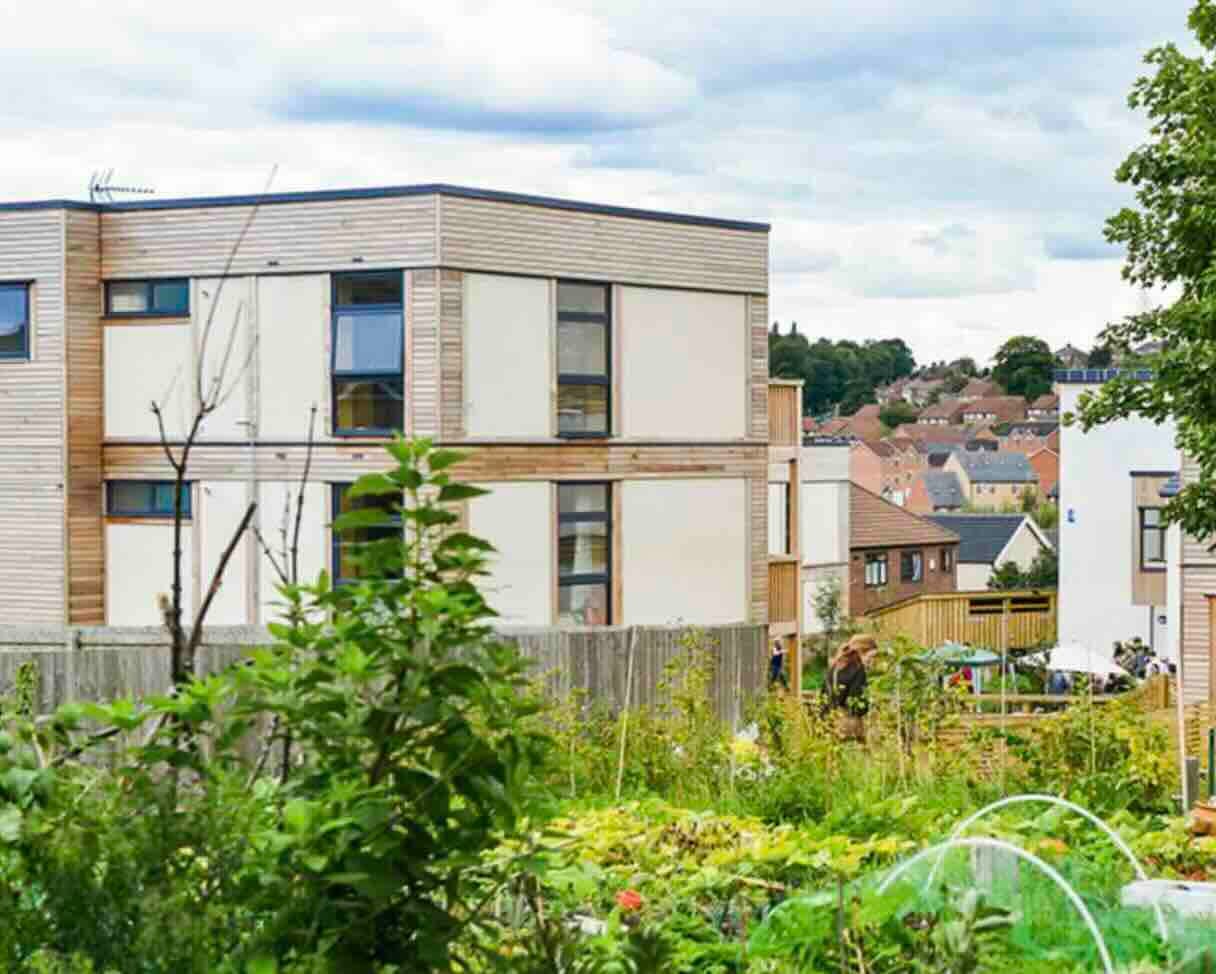
IT is a housing model that is still at the “pioneering stage”, according to its inventor.
And, in truth, Paul Chatterton confesses to being “a little disappointed” that, after over ten years of operating pretty much without a hitch in the cluster of houses (called LILAC) he now calls home, his ideas have yet to become mainstream.
Chatterton is now a professor at the University of Leeds, and, indeed, at first glance, it might feel that a PhD in mathematics is required to make sense of it all.
Please note, this article was first published on another website run by Mike Wilson (editor of BuildEdinburgh.com) in July 2024. So, for BuildEdinburgh (even though not launched until May 2025), this publication date recognises both sites.
But, if the challenge is to find that snappy slogan, one could do worse than: ’Want to live in a home costing no more than 35 per cent of your net income?’
Because LILAC does not make any great claims about providing ‘social rent housing’ or being the complete answer to the country’s housing crisis.
Instead, it sees itself as a possible answer to that ‘middle cohort’ of people who are not conventionally poor but are still finding it almost impossible to get on the ‘first rung of the housing property ladder’.
Everything else is almost beside the point (except they are huge for the LILAC residents themselves), such as the fact that the principal building material for the houses is straw, OR that a ten per cent deposit is required to begin to secure a property, OR that the houses are designed to near ‘Passivhaus’ energy efficiency standards, OR that the residents choose to live in a sharing and caring way under the auspices of what is best described as ‘Cohousing’.
It’s not for nothing that LILAC stands for Low Impact Living Affordable Community.
It is the mechanics of getting the show on the road in the first place - and then keeping it going for year after year - that similar ‘housing pioneers’ should be most interested in.
It was in 2006 that Chatterton helped start a cohousing group in Leeds, looking for land to set up their own housing.
They found it in a site west of the city centre, that had previously been occupied by a primary school.
The breakthrough thought was arguably interrogating people’s seeming obsession with the idea of ‘ownership’.
Because, at LILAC, its residents don’t own their individual homes; instead, they own the right to live in a LILAC home, so long as they can keep up with their 35-per-cent-of-net-income payments.
And whether it’s a lump sum that has been put into LILAC by - say - a retired couple who have sold an existing property, or a ’35 per cent’ monthly payment, it all converts into equivalent £1 equity units in the organisation, which can be cashed in on moving out.
There’s a fair bit of tweaking here and there, to help make some of the numbers stack up and to ensure fairness, such as accounting for depreciation of the properties and ongoing care, maintenance and insurance costs. And there is no such thing as a ‘void’ house; ie no-one gets their money back until they are able to sell their equity units to the next occupant of their home.
But broadly-speaking, the ‘ownership’ that many people might crave is in the whole entity - known legally as a Mutual Home Ownership Society, a membership co-operative registered as an Industrial and Provident Society with the Financial Conduct Authority.
And it was that entity - the MHOS - that was successful in securing a 70 per cent mortgage from Triodos Bank, to pay for the land purchase (Chatterton says he is grateful to Leeds City Council for being flexible in when it had to be paid) plus the subsequent groundworks and house-build.
Says Chatterton: “Because it was the MHOS that took out the loan with Triodos, we saved quite a bit of money compared to each household having to take out their own, individual mortgage.
“The remaining 30 per cent [between the Triodos loan and what was finally needed] was made up by people forward-buying equity units.”
In total, it was a £2.4m build (land included), begun by requiring members of the cohousing group that Chatterton helped start paying an upfront, pretty much non-refundable £5,000, to pay for solicitors, surveys, planning permission and other preliminaries.
The £5,000 had the additional effect of smoking out people who, ultimately, were not up for it. Adds Chatterton: “It can be emotionally very tiring setting up a MHOS; you need people who are committed.
“And you need that initial commitment to continue, since there is ongoing financial management of the scheme, for which we have a dedicated task team, made up of volunteer residents.”
And on those rare occasions when a resident is unable to pay their ’35 per cent’ monthly payment (which can be otherwise described as a ‘monthly charge that buys equity units’), there are reserves that have been built up to ensure that never will a month go by when the mortgage cannot be paid.
As to why, 35 per cent? It was, and is, considered a reasonable ask, especially when compared with how much many people are having to find each month to provide a roof over their heads.
A minimum net annual income is required to be considered eligible for the ‘35 per cent’ facility; for instance, a combined minimum of £30,000 (net, and depending on the size of the deposit lodged) for a two-bedroom flat.
Chatterton continues: “We have built up reserves because there are some residents who can purchase more shares than they technically need, to buy the lease to their home.
“When it comes to valuing the equity units should anyone leave - and we have had a handful of people leave us since we all moved in together, in 2012 - we use wage inflation as opposed to the much higher house price inflation figure as a measure of the increase in their value.
“In other words, the really exciting aspect is that an MHOS builds in ‘permanent affordability’, from one lease to the next.
“And the fact that only a few households have moved out since we all moved in says everything you need to know about how cohesive the community is and what a fantastic environment it is to bring up children or to grow old.”
There are 20 homes on the site, each built mainly with straw (by Bristol-based Agile Homes - who happen to feature a photo of LILAC on the front page of their website).
There’s a communal garden - with a thriving pond - and a common house comprising a kitchen, dining room, a guest room and a ‘parlour’ for games, meetings and cinema. The oldest resident is in their late 80s, the youngest is under one.
Not surprisingly, the mix of Cohousing and mutual home ownership makes LILAC something of a trailblazer.
It regularly hosts ‘open days’, where prospective MHOS projects can find out more; the next one scheduled to take place in the autumn.
There is a book too, penned by Chatterton himself (here).
And, while not averse to providing individual consultancy, he is in negotiation with Agile Homes to provide a ‘turnkey’ package for prospective groups.
While housing developers have yet to embrace the concept in the way that Chatterton would have liked, scores of projects around the country have taken elements, and at least one firm of solicitors (such as Wrigleys, which has offices in Leeds, Sheffield and Newcastle) has been convinced, offering legal advice to anyone looking to set up a MHOS - in Wrigleys’s case, in England only.
Mike Wilson is editor of BuildEdinburh.com
Please note, this article was first published on another website run by Mike Wilson (editor of BuildEdinburgh.com) in July 2024. So, for BuildEdinburgh (even though not launched until May 2025), this publication date recognises both sites.
Image details: LILAC, Leeds; copyright Andy Lord / LILAC